The first €100 million of Inclusive Sustainability-Linked Financing (ISLF+)
The JuST Institute’s Inclusive Sustainability-Linked Financing (ISLF+) product has enabled the disbursement of €100 million over the first two years pilot phase to support inclusive financial service providers (IFSPs)1 and small and medium-sized enterprises (SMEs) integrate climate, biodiversity, socioeconomic inclusion, and the just transition into their institutional and financial practices.
Upcoming partnerships and projects are already unlocking more financing across these scopes, and we look forward to expanding the use of this instrument with any interested parties.
Amidst the global crisis of climate change and biodiversity loss, there has never been a more urgent need to invest in environmental sustainability and climate resiliencies while ensuring no one is left behind. This concept – of shifting towards a greener economy and support adaptive capacity, while simultaneously supporting vulnerable populations who are often left behind in economic transitions – is known as the “just transition.”2
At the Just Sustainability Transitions (JuST) Institute, our vision of a just transition is for every financial institution to be equipped to integrate climate, biodiversity, and socio-economic inclusion into their institutional practices and investments to finance a greener, more resilient, and equitable world. We are working with multiple partners3 to contribute to lead the way through a combination of guidelines4, practical training and capacity building, analysis and certifications, strategic and operational advisory, and innovative financial products such as the Inclusive Sustainability-Linked Financing (ISLF+) instrument. Read our story below to learn more about our ISLF+ framework and how it mobilizes financing to foster more resilient ecosystems and the enterprises and communities who depend on them the most.
Barriers to financing the just transition
The environmental-social gap
A key challenge faced by investors is designing financial products that can generate positive social and environmental benefits for their clients and support adaptation to climate change and biodiversity erosion, all while being financially sustainable. Financial institutions (including conventional banks, microfinance institutions, and cooperatives) and enterprises (from SMEs to large corporations) across all regions face structural barriers in accessing financing dedicated to a just transition. There lies an untapped potential to strengthen the capacity of financial institutions to tailor climate-smart, biodiversity-positive and socio-economically inclusive products for their clients. This shift is increasingly critical, as inclusive financial service providers (IFSPs) often serve the most vulnerable clientele who have the fewest resources and capacity to adopt practices and technologies that would enhance their own resilience to environmental shocks.
Existing tools and financial products often focus on either social or environmental objectives, rarely both. Further, products usually require that investees demonstrate a proven track record of achieving sustainability goals. This pre-requisite means that these tools – which are meant to support investees in becoming greener or more socially inclusive – are generally restricted to larger enterprises due to their high operational costs and necessity for enhanced data systems for monitoring and reporting. As a result, current financial practices and products are generally limited in their capacity for inclusivity and transformation of sustainable financing.
At the JuST Institute we believe that to support a just transition – fostering environmental resilience amidst the growing threats of nature loss and climate change without compromising the needs of vulnerable populations – we need to design incentives for enterprises and financial institutions of all sizes, as well as actors with and without proven track records in environmental and social action, and we need to ensure that both environmental and social goals are pursued together.
Bridging the gap: The ISLF+
The Inclusive Sustainability-Linked Financing (ISLF+) is a financial product that enables and rewards investees for making material and/or transformative progress toward a greener, fairer, and more climate-resilient economy and society. The ISLF+ links better financial and/or extra-financial conditions to the third-party verification of achievement of environmental, social, and just transition targets by the investee. These incentives aim to enable enterprises and financial institutions with or without a track record in sustainability and social goals to access financing opportunities for transformation — as well as technical assistance to achieve this transformation — so long as they show progress towards achieving their goals.
The ISLF+ was developed in 2022-23 by the JuST Institute and co-executed starting from 2023 by the JuST Institute and BNP Paribas to help enterprises and financial institutions of all sizes and geographies to overcome barriers they face in accessing green and socially inclusive finance.
By gaining access to improved financial or extra-financial benefits when they achieve specific social and environmental targets, investees can gain lasting benefits from enhanced capacity and financial opportunities. Investors, in turn, can support the development of more sustainable, inclusive, and resilient portfolios with the assurance that outcomes of their investments are measured, verified, and proportionately rewarded.
This financial and extra-financial support aims to support investees and investors in integrating just transition targets into their activities and portfolios. The original ISLF+ projects were financed by BNP Paribas and are now being adapted and scaled to further deals with BNP Paribas other partners including the International Fund for Agricultural Development (IFAD), the Global Environment Facility (GEF), and beyond.
One of the unique elements of the ISLF+ is its “transformative” approach – how it can support institutions with little to no track record in environmental or social results strengthen their capacity to measure and implement activities in these key areas.
The transformative nature of the ISLF+ approach can be seen, for example, with microfinance institutions such as Brazil’s Banco da Familia (BdF) and Italy’s PerMicro, both already leaders in social impact in their respective countries. After participating in the JuST Institute’s ISLF+ training and capacity building efforts, BdF and PerMicro introduced climate vulnerability and environmental impact criteria into their loan assessments for the first time. This important shift was made possible by a tailored combination of technical assistance and financing. Moreover, the monitoring and reporting systems of these investees improved and has enabled them to expand the scope of their future activities through the addition of new environmental metrics and indicators. Improved measurement processes highlight both institutions’ commitment to a just transition, expanding their potential for generating a positive environmental impact and opening doors to new financing opportunities. Such improvement in the identification of risks and opportunities has allowed the two institutions to focus on expanding their current offer of green loans for green practices and technologies to support their clients’ own resilience.
The transformative journey
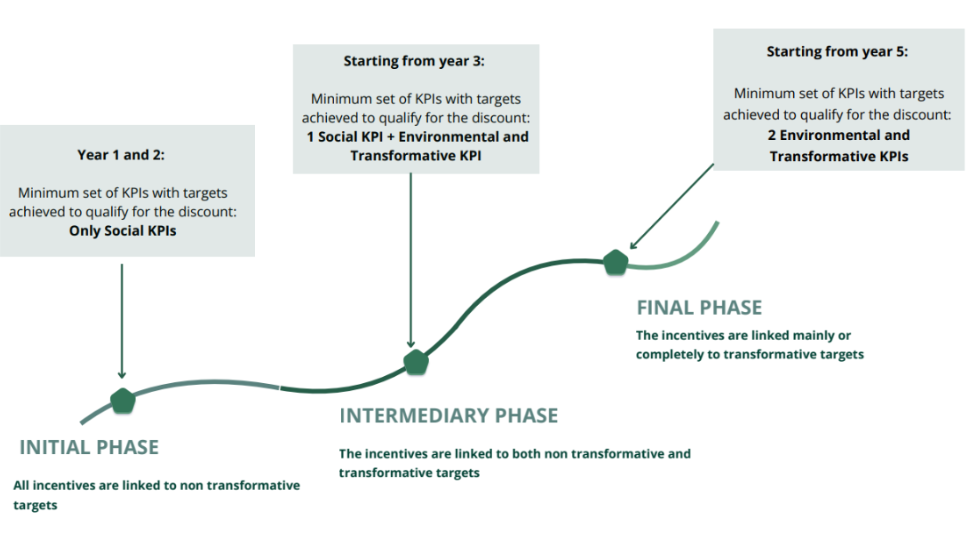
At the heart of ISLF+ lies the Transformative Journey: a roadmap of Key Performance Indicators (KPIs)5 and Sustainability Performance Targets (SPTs) tailored to each investee. KPIs are used to track the progress towards the primary goals of each activity and fall into one of three categories: Social, Environmental, or Just Transition (which simultaneously promotes both social and environmental objectives). The transformation roadmap for each investee must include at least one KPI that is transformative, signaling a material shift compared to prior practices of investees. Moreover, the transformation roadmap for each investee must include at least or both one Social KPI and one Environmental KPI, or at least one just transition KPI, signaling a material focus on both social and environmental results.
Sustainability Performance Targets (SPTs) are defined per KPI and are used to track the progress towards each KPI. Their values are defined in function of the baseline and track record (if it applies) and need to show improvement with respect to the baseline. The goal of the ISLF+ is to support institutions in designing and achieving transformative KPIs that support the just transition.
The deadline to achieve SPTs is the end of the Sustainability Reference Period, after which investees’ progress is verified, and, if the SPTs for the given period are achieved, incentives (financial or non-financial) are distributed. The journey may cover one or multiple financing cycles, supporting a shift to just transition activities (those which integrate both social and environmental targets) based on the JuST Institute Framework. See the diagram below for an example of a transformation journey for an ISLF+ loan.
Incentives and support: Rewarding both results and progress
A key feature of ISLF+ is the way it supports and rewards institutions for making real progress on inclusive and sustainability goals, rather than tethering financial incentives exclusively to final or absolute outcomes. To achieve this, the framework offers two types of incentives designed to motivate and support investees along their transformation journey.
1. Ex-ante Support
Ex-ante support provided at the beginning of the financing journey is designed to give institutions a helpful push as they start their sustainability efforts. This can include lower interest rates or early access to technical assistance that support internal capacity development and strengthen their ability to meet environmental and social goals. Examples of ex-ante support include training and capacity building or strategic and operational advisory.
2. Ex-post Incentives
Ex-post incentives are rewards given during the financing period, but only if the institution reaches the agreed Sustainability Performance Targets (SPTs) within each reference period. Upon meeting the targets, the investee can benefit from better financing terms or accessing additional support through tailored technical assistance. By linking better conditions to real progress, the ISLF+ supports institutions in achieving both their financial, social, and sustainability goals and is often interlinked with an increased management capacity of climate and biodiversity risk in their portfolios.
What results are rewarded?
Examples of targets that have been rewarded include the expansion of portfolio of activities and products tailored to women, people living below poverty line, smallholders, among others; expansion of the green portfolio for example dedicated to clean energy, sustainable mobility, sustainable agriculture, energy efficiency, circular economy, biodiversity conservation; increased use of tools to identify and measure climate, biodiversity, and environmental risks, and beyond.
Beyond financing: Technical assistance
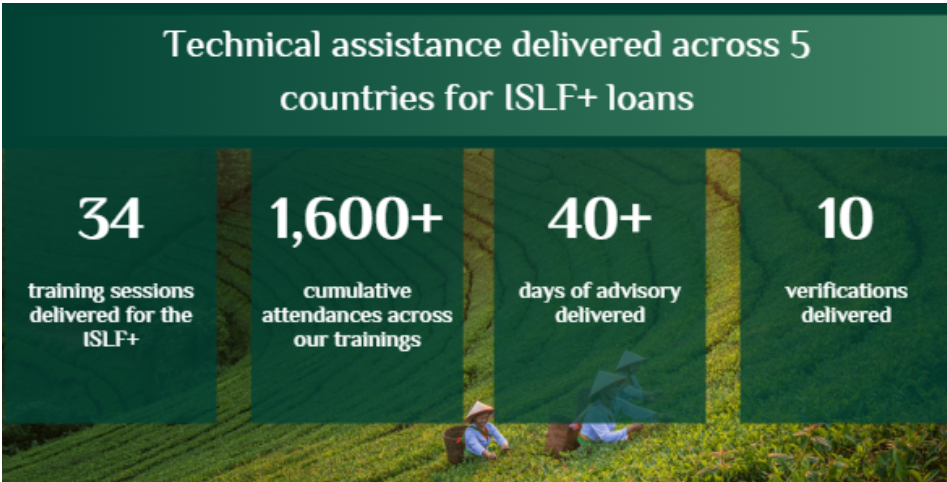
One of the defining features of ISLF+ is the integration of Technical Assistance (TA) as a core component of the financing framework. TA is essential for enabling financial institutions and corporates to pursue and achieve their social and environmental goals as it not only supports implementation, but also reinforces accountability, learning, and long-term transformation.
The JuST Institute offers three types of TA, each designed to respond to different needs along the journey toward impact.
First, Ongoing Technical Assistance (OTA) ensures that the path to sustainability is consistently reviewed, monitored, and evaluated. This includes regular – typically semi-annual – reviews of an institution’s progress toward predefined Sustainability Performance Targets (SPTs). At the end of the Sustainability Reference Period, reviews are conducted either by the JuST Institute or by external auditors, ensuring accountability and transparency. Upon verification of the achievement of SPTs, the investee is eligible to receive the discounted interest rate for their loan or co-financed technical assistance.
Second, institutions can benefit from Specific Technical Assistance (STA) tailored to their operational challenges and strategic goals. The STA can take various forms, including but not limited to:
- Training sessions on topics like climate adaptation, biodiversity, and green finance
- In-depth advisory services related to green products and the identification, monitoring, and management of climate and biodiversity risks and opportunities. Examples include the development of vulnerability indicators, green taxonomies and product scopes, and opportunities for financing nature-based solutions (NbS),
- Certification and analysis for institutions and portfolios for climate, biodiversity, and inclusive finance.
STA comes in two forms: Upfront or Sustainability-Linked.
- Upfront Technical Assistance involves institutions receiving support prior to the achievement of any targets, with the purpose of enabling them to do so. This allows institutions with little or no track record to confidently commit to transitioning to greener and more inclusive practices.
- Sustainability-Linked Technical Assistance is performance-based and is only provided when an institution has met pre-defined sustainability targets. These targeted interventions function as rewards for investees who have committed to achieving their targets and help to strengthen internal capacity and align the institution’s practices with international sustainability standards.
“The training provided by the JuST Institute was key in this process, with tools such as MEbA indicators, the FAO Ecocrops database, and Nature-Based Solutions (NbS) methodologies. These learnings enhanced our governance, broadened the strategic vision of our leadership, and made our services more efficient and responsive to rural realities.”
Elaine Amaral – Market Director of Banco da Família (Microfinance Institution from Brazil)
In practice: Small and Medium-sized Enterprises (SMEs)
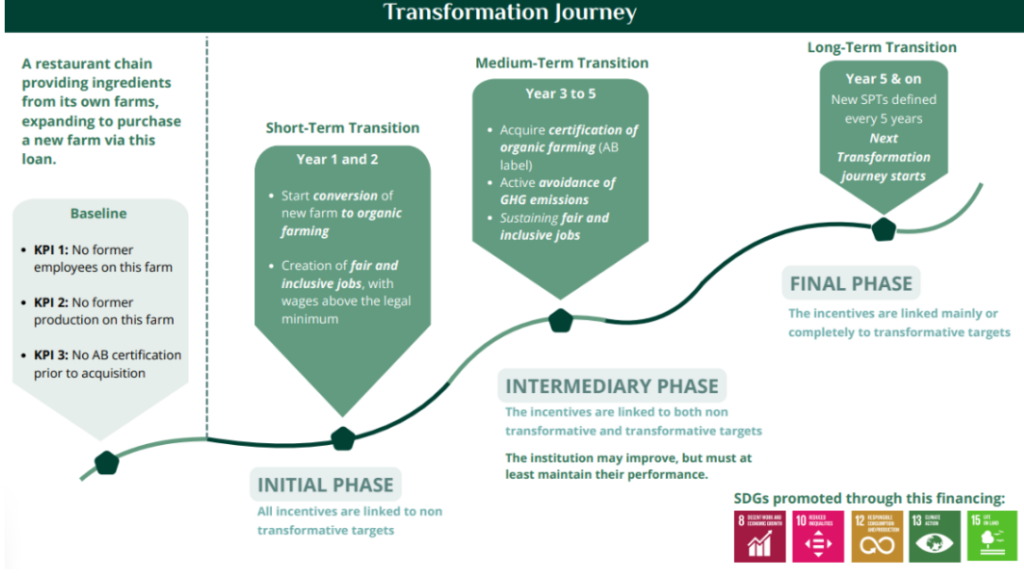
A primary example of the ISLF+ being implemented in SMEs is seen in our recent partnership with Mûre, a France-based farm-to-fork restaurant chain. Alongside BNP Paribas, the JuST Institute closed an ISLF+ to finance the purchase of a farm to transform it in agroecology and producing seasonal ingredients for Mûre’s restaurants.
As the goal of the ISLF+ is to reward progress toward a just transition, we supported Mûre and its investor, BNP Paribas, in designing specific transition indicators for their activities (see example diagram below). Key indicators for Mûre included:
- Sustainable Production: Exclusively producing organic fruits and vegetables.
- GHG emission reduction: reduction of GHG per each unit of agriculture products produced.
- Social equity: Paying farm workers 110% of the minimum wage.
If these transition objectives are achieved, Mûre will benefit from a reduced interest rate from BNP Paribas, directly linking financial incentives to positive social and environmental impact.
« We are honored by this recognition of the social and environmental commitments embodied by our new Mûre farm in Balloy (France). Our heartfelt thanks go to Davide Forcella and the entire JuST Institute team for a fruitful and enduring collaboration. »
Bertrand Jelensperger – Group CEO of Mûre (farm-to-table restaurant based in France)
In practice: Inclusive Financial Service Providers (IFSPs)
With the financial support of BNL (BNP Paribas Group), the JuST Institute signed an ISLF+ contract with the Italian financial intermediary PerMicro with the aim of enhancing the environmental and social impact of its portfolio. PerMicro, which grants small loans to microenterprises across Italy, implemented a roadmap co-designed with the JuST Institute to develop social, environmental, and just transition (encompassing both social and environmental objectives) KPIs.
As part of PerMicro’s ISLF+ contract with BNL (BNP Paribas Group), multiple targets were monitored, such as:
- The volume of microcredits granted to microenterprises run by young people and women
- The value of the portfolio dedicated to financing green technologies and practices
- The volume of the loans assessed with environmental impact and climate vulnerability indicators.
Upon the verified progress towards these just transition targets, PerMicro will receive a discounted interest rate on their loan from BNL (BNP Paribas Group).
PerMicro has continued to expand its environmental and social impact through the development of the PerMicro Cares initiative, which is dedicated to helping families implement sustainability measures in their homes and communities. Examples include loans for purchasing electric or hybrid cars, as well as supporting home energy efficiency measures and solar panel installations.
In line with goals developed alongside the JuST Institute, PerMicro also aims to support microenterprises that demonstrate a strong environmental commitment, specifically targeting businesses that demonstrate a positive environmental impact in their mission statement, or those developing a dedicated green investment or product line.
Our partners and results
The JuST Institute has enabled the disbursement of more than €100 million of ISLF+ in three regions, mobilizing private funds from European banks such as BNP Paribas. By collaborating closely with our global network of partners, we have successfully mobilized just transition finance across Europe, Africa, and Latin America. This funding, beyond generating immediate capital for motivated investees, creates a foundation for long-term institutional capacity to support the just transition. We are empowering our investees to move beyond generic sustainability goals by providing the technical resources and governance frameworks necessary to develop, monitor, and achieve rigorous just transition targets that foster economic growth, environmental sustainability, and social equity, and are tailored to their strategic priorities and beneficiaries.
This collective effort is contributing to the decarbonization of local economies while improving access to finance for underserved populations.
“The GEF is proud to support the deployment of inclusive and sustainability-linked financing through the GEF Challenge Program for Adaptation Innovation, with funds from the Least Developed Countries Fund and Special Climate Change Fund, in partnership with Grameen Credit Agricole, BNP Paribas, IFAD, and the JuST Institute. Financial inclusion enables locally led adaptation and resilience. It is crucial that green finance reaches the most vulnerable, with accessible and equitable terms.”
Jason Spensley, Senior Climate Change Specialist – Global Environment Facility
Looking ahead
Our goal is ambitious yet clear: To build a financial ecosystem that rewards material and verified achievements toward the just transition, with lasting impact in the governance, monitoring, and internal capacity of financial institutions to continue their progress towards a more sustainable and just world. Investees benefitting from the ISLF+ mechanism are supported to continue their transformative journey beyond the lifetime of the financing. We aim to expand the ISLF+ within our member institutions, partners, and throughout the financial sector and beyond through projects and programs.
At the JuST Institute, we believe that the ISLF+ is an instrument that can enable the financial sector to improve its pricing and become more resilient amidst concerning climate and biodiversity loss scenarios – meaning the institutions that choose to adapt will benefit from lower risks, enhanced access to favorable financial conditions, and have the capacity to design more sustainable financial products for their clients.
Building on the demonstrated success of the ISLF+ with private capital, the JuST Institute aims to expand the impact of the ISLF+ with a designated blended finance pool to accelerate funding for the just transition. This fund combines public and private capital to co-finance both financial and non-financial incentives for institutions that meet their transformative targets.
We look forward to continued collaboration with our partners and invite you to join us in our mission of financing the just transition.
————–
Are you an investor seeking to align financial returns with inclusive, sustainability-linked financing?
Are you an IFSP or SME looking for financing and capacity while advancing your social and environmental goals?
Discover how the ISLF+ can help you drive meaningful, measurable change.
Contact us: contact@justinstitute.org
If you’d like to learn more about the ISLF+, please explore the following resources:
- Supporting microfinance actors in France, Italy, and Brazil (link)
References
(1) Inclusive Financial Service Provider (IFSP), which includes Micro Finance Institutions (MFIs), fintech, local SME banks, cooperatives, etc. financing poor households, smallholders, Micro-, Small and Medium-sized Enterprises (MSMEs).
(2) What is just transition? And why is it important? | UNDP Climate Promise
(3) Members and Partners of the JuST Institute include: Global Environmental Facility (GEF), BNP Paribas, Fondation Grameen Credit Agricole, International Fund for Agricultural Development (IFAD), Frankfurt School of Impact Finance, Appui au Développement Autonome (ADA) VisionFund International, Naturalis Biodiversity Center, and Gojo & Company, Inc.
(4) The JuST Institute has also collaborated with the UN Environmental Program on Financial Inclusion (UNEP-FI) and the International Labor Organisation (ILO) on the topic of inclusive just transition finance. Check out the publication here
(5) In the context of sustainability-linked financing, KPIs are metrics that track the borrower’s performance on sustainability goals (e.g., number of women entrepreneurs financed, CO₂ emissions reduced, % of renewable energy used).